
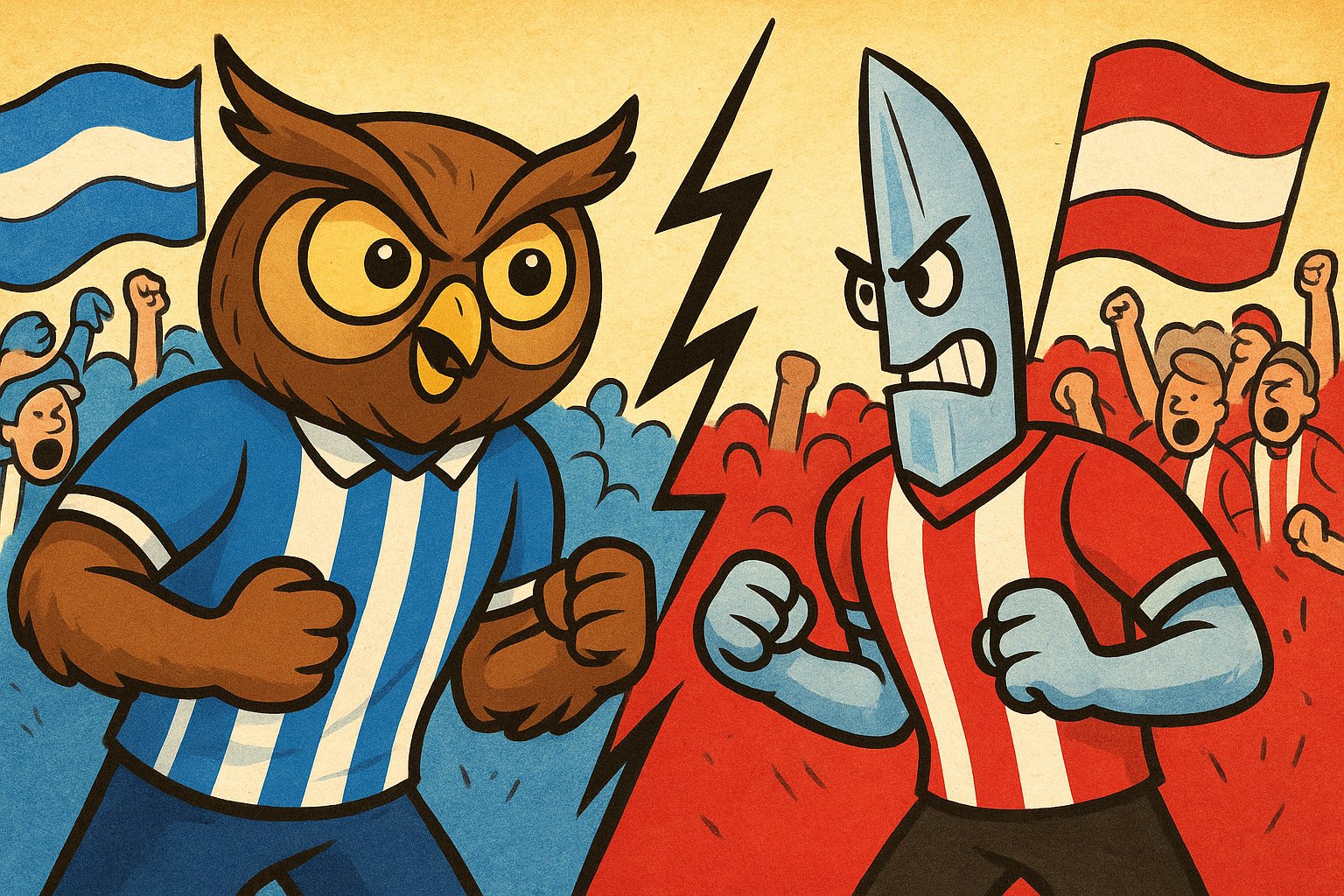
“Steel City Showdown: When Owls and Blades Go to War”
Ah, Sheffield. Famous for steel, music, and more hills than any sane person should ever cycle up. But mention football, and you’re not just talking about the game—you’re diving headfirst into one of the fiercest, funniest, and occasionally frightening rivalries in English football: Sheffield Wednesday vs. Sheffield United.
This isn’t just a football match. It’s the Steel City Derby. It’s bragging rights at the workplace. It’s who gets to shout louder in the pub. It’s neighbours not speaking for a month. It’s Owls against Blades, blue and white against red and white, and it makes Christmas dinner in Sheffield families… complicated.
The Origins: Two Clubs, One City, Endless Trouble
Sheffield Wednesday were founded in 1867, which means they’re basically football dinosaurs. United came along later in 1889, moving into Bramall Lane and immediately deciding they didn’t fancy being the little brother. Thus, the city was split down the middle: Owls on one side, Blades on the other, and everyone else quietly wondering if they could just support Rotherham to avoid the arguments.
Owls vs. Blades: A Nickname Battle in Itself
The rivalry isn’t just on the pitch—it’s baked into the very names. Wednesday fans proudly call themselves Owls, a nod to their old Owlerton ground. Blades fans, meanwhile, embrace Sheffield’s steelmaking heritage with a name that suggests you should not argue with them in dark alleys.
It’s quite a contrast: one side wide-eyed, swivelling their heads, going “hoot.” The other side sharpening knives and whispering, “Come on then.” If David Attenborough ever covered football derbies, this would be his favourite episode.
The Matches: Mayhem, Memories, and Misery
The Steel City Derby has produced moments that fans talk about for decades:
- 1991 FA Cup semi-final: Wednesday beat United at Wembley. Ask an Owl about it, and they’ll give you the exact minute, weather, and what pie they ate.
- The 2003 classic: United thumped Wednesday 3-1. Blades fans still grin about that one like it happened yesterday.
- That time United fans released pigs painted blue and white onto the pitch: A prank that went about as well as you’d expect when wrangling livestock.
Every derby is unpredictable. A 30-yard screamer? Possible. A 0-0 with 27 yellow cards? Also possible. Either way, the drama is guaranteed.
The Banter: Where Creativity Peaks
If you think footballers are athletes, you should see the fans’ vocal cords after 90 minutes of chanting. The banter between Owls and Blades is legendary. Songs, taunts, banners—no joke is too low-hanging.
- Wednesday fans love to chant about United’s relegations.
- United fans counter with reminders that they’ve been in the Premier League more recently.
- Both sides sing about each other’s stadiums, accents, and grandmothers’ baking skills (probably).
It’s relentless, it’s passionate, and it’s occasionally incomprehensible if you’re not from Sheffield.
The City Itself: Divided, but Proud
On derby day, Sheffield becomes a different place. Taxi drivers argue with passengers. Bartenders “accidentally” serve pints of the wrong colour. Even fish and chip shops aren’t safe—red napkins on one side of town, blue on the other.
Families often have both Owls and Blades under one roof. Picture it: Dad’s in red and white, Mum’s in blue and white, and the kids are trying to stay neutral in grey hoodies until they figure out which inheritance will be bigger.
Why It Matters So Much
To outsiders, it might seem ridiculous. Two sets of fans screaming at each other over 90 minutes of football. But in Sheffield, this derby is everything. It’s identity, heritage, and local pride. It’s two sets of fans who wouldn’t swap their side for the world—even if it means decades of heartbreak.
Because whether you’re an Owl or a Blade, the Steel City Derby gives you stories, laughs, tears, and the occasional need for throat lozenges. And at the end of the day, Sheffield as a city wins—because no other place can boast a rivalry quite like it.
Final Whistle
So the next time you hear Sheffield Wednesday and Sheffield United fans trading chants, remember: this isn’t just football. This is steel, sweat, sarcasm, and sibling-like hatred rolled into one.
Owls versus Blades. One city, two tribes, and a rivalry sharper than, well, a blade—and louder than an owl hoot at 3 a.m.